Puppy
Light hardware, gentle introductions and frequent fit checks as your puppy grows.
Read the detailHead & Paws · Practical equipment guide
Different dogs, different needs. Understand the options, check the fit and choose features that help your dog feel comfortable and secure. Equipment supports kind training; it does not resolve fear, pulling or reactivity on its own.
Inspect straps, stitching, buckles and attachment points for damage.
Follow the manufacturer’s fitting instructions. Check movement, rubbing and escape risk; extra straps alone do not guarantee security.
Fasten and check every clip and lead connection in a secure place. Recheck after growth, coat changes or adjustment.
Measure your dog using the maker’s instructions; size labels differ between brands. Check straps sit clear of the throat and do not rub behind the elbows, twist or restrict normal movement. In a secure space, watch the dog walk and gently check whether backing up lets the harness slip. Stop if your dog is distressed; do not pull hard to test it.
A third strap behind the ribcage may improve escape resistance when correctly fitted, but no harness is escape-proof. Front and back attachment points have different handling effects: follow the design instructions and prevent the lead catching under the legs. Recheck fit over winter clothing and after removing it. For two dogs, check each fit separately; choose leads you can manage independently. Seek fitting help if you cannot achieve comfort and security.
Targeted practical addition checked 24 October 2026. General editorial guidance; examples are illustrative, not clinical review or guaranteed outcomes. Source in English: Bath Cats & Dogs Home
| Situation | Options to consider | Important limits |
|---|---|---|
| Everyday walks | Comfortable harness + fixed or adjustable lead | Keep identification separate from the choice of restraint; teach loose-lead skills. |
| Recall in clear open space | Long line on a suitable back-clip harness | Manage slack and distance; avoid traffic, livestock and entanglement. |
| Backing out / narrow shoulders | Individually fitted escape-resistant design | No guarantee: check neck opening, girth, rear strap and safe backup. |
| Muzzle needed for a walk | Suitable basket with full panting room | Check drinking, fit, purpose and supervision; introduce with rewards. |
Choose all that apply. These are features to consider, not a prescription or a product recommendation.
Choose a consideration to see relevant guidance.
Light hardware, gentle introductions and frequent fit checks as your puppy grows.
Read the detailProportionate straps and clips; assess anatomy and comfort rather than a breed label.
Read the detailConsider a properly fitted three-strap harness and suitable backup attachment. No harness is escape-proof; plan quiet routes and safe exits.
Read the detailA comfortable harness and fixed or double-ended lead can support gentle handling. Front clips may alter movement under tension. Reward loose-lead walking; avoid jerks.
Read the detailA long line on a suitable harness back attachment can support recall practice in a safe area. Manage slack and never wrap it around your body or hands.
Read the detailPrioritise space, secure fit and a safe exit. A positively introduced basket muzzle may add safety where appropriate; it does not replace a behaviour plan.
Read the detailLook for easy fastening and comfortable contact. Ask your veterinarian about pain or gait changes; use a purpose-designed support aid if lifting is needed.
Read the detailA well-fitted harness or suitable flat collar with a fixed lead offers predictable handling. Check clips and identification before leaving.
Read the detailUse close control near livestock and roads; follow local restrictions. Long lines can snag. Plan water, visibility and a route suited to your dog.
Read the detailAn appropriately fitted anti-scavenging basket design may help, provided full panting and drinking remain possible. It cannot remove all risk; combine supervision and leave/drop training.
Read the detailChoose a suitable basket design with full panting room, then reward voluntary nose entry before gradually introducing straps and movement.
Read the detailCheck rated hardware and your grip and balance. Use a manageable fixed lead; seek help before walking where a sudden pull would exceed your control.
Read the detailSeparate leads allow independent spacing. Couplers transfer pulls and suit only compatible calm walkers; consider two handlers or separate walks for mismatched needs.
Read the detailAsk your veterinarian about pressure points, activity and support needs before choosing. Equipment cannot diagnose or treat illness. Breathing difficulty or collapse needs urgent veterinary help.
Read the detailA coat ring must be designed for restraint. Check fit with the actual layers, rated attachments and warmth without overheating; a decorative ring is insufficient.
Read the detailA · Girth
All the way around the widest ribcage behind the front legs.
B · Chest width
Across the front; follow the model’s exact measuring landmarks.
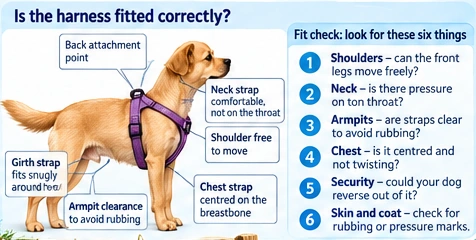
Measure as directed for that design. Straps should be snug without compressing breathing, skin or movement; finger clearance is a guide, not a universal sizing rule. Check six things: free shoulder movement; no throat pressure; clear armpits; a centred chest section; security against reversing out; and no rubbing or pressure marks. Watch walking, turning, sitting and backing up in a secure area. Recheck after settling, coat changes, washing, weight changes and puppy growth. Replace damaged stitching, clips or webbing.
With your dog standing comfortably, use a soft tape around the widest ribcage just behind the front legs for girth. Keep it flat without compressing the coat. Chest width means the distance across the front of the chest; it is not the same measurement. Brands use different landmarks: also measure lower neck, chest length or rear strap position if their chart asks. Record centimeters and compare the exact model’s chart, not another brand’s size. Never add a fixed allowance unless instructed.
In a secure area, watch several comfortable steps and turns. Stop for a shortened stride, elbow contact, redness, hair loss, pressure on the throat or straps sliding into the armpits. Do not pull a dog backwards to test security. If the dog reverses, avoid hauling forward against a tightening lead; move with them where safe, reduce tension and return to a secure space for refitting. A third strap must follow the maker’s position, without compressing the soft abdomen. A short compatible backup can link independent secure attachments, but must not tighten the throat, drag, snag or loop around legs; seek fitting help. Inspect stitching, buckles, clip closure and webbing before walks. Clean as instructed, rinse off salt/grit, dry fully and replace damaged parts rather than tying repairs.
Compare shapes, attachment points, escape resistance, support and coat harnesses.
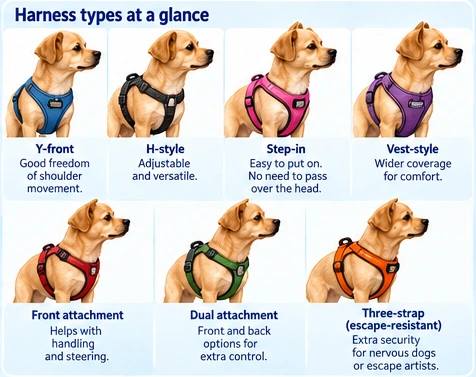
The chest straps form a Y when viewed from the front. Look for space around the shoulders and neck, with the centre resting on the breastbone rather than the throat. The name alone does not guarantee unrestricted movement or a good fit.
Usually has neck and chest loops linked along the back and underneath. Adjustment can suit different proportions, but check that straps stay clear of the armpits and do not twist.
The dog places their front feet into openings before fastening. This may help a dog who dislikes equipment passing over their head, but handling feet may worry another dog. Never force a leg into position.
A larger fabric area may feel comfortable for some dogs. Check heat, drying time, seams and freedom of movement; padding does not make a poor fit safe.
A back attachment keeps the lead away from the face and is usually the appropriate point for a long line. A front attachment can help gentle guidance but may turn the harness or affect gait under tension. Dual attachment allows a double-ended lead to connect at both points. Avoid jerks and continual sideways pressure; none teaches loose-lead walking by itself.
An additional strap behind the ribcage can make backing out harder when properly fitted. Escape-resistant does not mean escape-proof. Check the whole design, buckles and movement; consider an independently secured collar connection with professional fitting advice for a dog at risk.
A coat with a lead ring is suitable for restraint only if designed for that purpose: decorative rings, zips and hook-and-loop closures are not automatically load-bearing. Check the stated attachment, seams and fit with the actual winter layers; never size up a loose harness to cover a coat. A separate harness and compatible coat may fit better. Remove wet layers, monitor overheating and recheck straps after removal. Mobility-support harnesses or slings need veterinary/rehabilitation fitting; an ordinary grab handle does not make a harness safe for lifting or fall arrest.
Identification, fit, neck comfort and safety-release limitations.
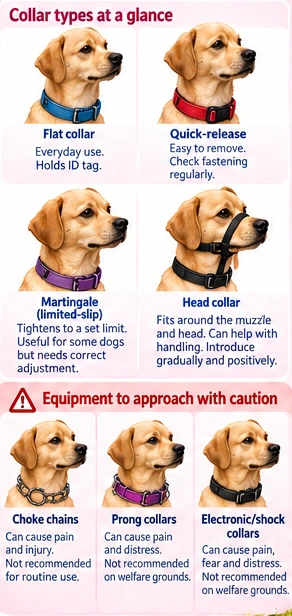
A flat collar can carry identification and suit a dog who walks comfortably without pulling. A quick-release buckle is a fastening type, not a guarantee that it releases under load or is escape-proof. Check fastening and fit, and keep loose loops away from snag hazards. A harness can reduce reliance on neck pressure while the identification collar remains in place.
Tightens to a set limit. It may help certain dogs whose head is narrower than their neck, but incorrect adjustment can still constrict or injure. Obtain fitting help; do not use it to correct pulling, attach a long line or leave a dog unattended.
Fits around the muzzle and head to guide direction. It is not a muzzle and does not prevent biting. Introduce gradually with rewards, use gentle handling and an appropriate backup connection, and never jerk the head or attach a retractable lead or long line. Stop if rubbing, panic or discomfort occurs.
Choke chains, prong collars and equipment delivering shocks can cause pain, fear and distress. Choose reward-based support instead of using discomfort to suppress behaviour. Legal restrictions vary by jurisdiction; do not infer legality from availability for sale. Ask a veterinarian about pain or sudden behaviour changes and seek a suitably qualified, reward-based professional.
A safety-release collar is designed to open under a specified load to reduce snagging risk. It is different from a manually opened quick-release buckle. Do not rely on it as the sole walking restraint: it may release during a pull. Follow its instructions, use a separate secure harness for walking and consider how identification remains attached. No collar makes unsupervised snagging safe.
Measure where the collar will sit and follow the size chart. Check comfortable finger clearance, normal swallowing and breathing, and whether it can slip over the head; do not tighten until uncomfortable to prevent escape. Identification carries contact details; restraint manages movement; reward-based training teaches skills. These are different jobs. For coughing, neck pain or known airway/cervical disease, ask your veterinarian about avoiding neck loading and a suitable harness. A collar does not itself establish the cause of illness.
Luke slipped while walking Odie and puppy Finn near Glencoe, dropping Finn’s retractable-lead handle. Its noise appeared to frighten Finn into running. MSPCA-Angell identifies this dropped-handle risk. For slippery or exposed routes, consider a manageable fixed-length lead and secure harness rather than extra reach; reassess whether you can safely handle two dogs. This is practical route-specific judgement, not a guarantee against accidents.
MSPCA-Angell: retractable-lead risks · Dogs Trust: reward-based recall
Fixed, adjustable, double-ended, long, retractable, hands-free and two-dog options.
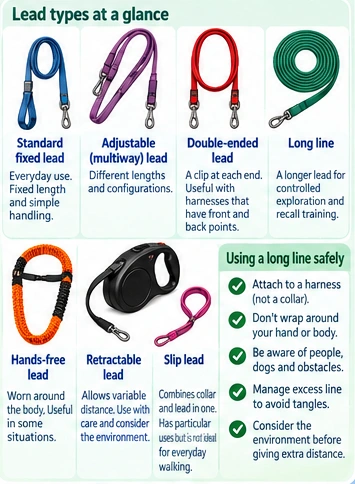
A standard fixed lead offers predictable length for everyday walking and close control. Adjustable/multiway leads change length or configuration: check that every clip is on a load-bearing attachment. A double-ended lead can connect to two suitable points; manage both ends without tangling legs or maintaining constant tension.
Use a suitable back attachment on a well-fitted harness, not a collar or head collar. Practise recall in a quiet, secure space before adding distance and distractions. Manage slack so a dog cannot accelerate into the end; never wrap line around hands or your body. Keep it clear of people, dogs, roads, livestock and obstacles. Gloves may reduce friction burns but do not eliminate injury risk. A long line is not a tie-out.
Hands-free designs attach to your body: consider balance, dog strength and a safe release before use. They may be unsuitable with sudden lunging or reduced stability. Retractable leads allow variable distance but can cause burns, entanglement and loss of control; avoid roads, crowds, close encounters and unpredictable situations. Do not grab the moving cord. A fixed lead is usually easier for close, predictable handling.
Combines a lead with a loop around the neck that tightens under tension. It has limited specialist handling uses but can compress the neck and is not a routine solution for pulling, puppies or fearful dogs. Seek professional advice where its use is necessary; do not use as a long line, tie-out or unattended restraint.
In a clear, quiet open space, a suitable retractable lead can offer controlled exploration if you can operate it reliably and prevent a run into the end. Match its rating to the dog, inspect the cord and test the lock before leaving. Shorten and lock before approaching a hazard, not at the kerb; a mechanism can fail. Keep distance from roads, livestock, wildlife, other dogs and people. A dropped handle may bounce or chase behind a frightened dog. For exposed, slippery or busy routes choose predictable fixed length; never attach a retractable lead to a head collar or use it to tether a dog.
Separate fixed leads allow each dog’s distance to be adjusted independently. A coupler shares one main attachment and can transfer one dog’s pull to the other; consider it only for compatible dogs already walking calmly together. Different sizes, pace, fear or reactivity favour separate leads, two capable handlers or separate walks. Stop safely before crossing leads tighten; guide dogs back to separate positions while keeping clips attached. A swivel may reduce axial twisting but cannot prevent crossed leads or loops around paws. Never release a dog beside traffic to untangle.
Clips can rotate as dogs cross, circle you or change pace. Twisting within a lead differs from two leads crossing: neither is solved simply by buying a swivel. Use manageable fixed lengths, practise a familiar walking position and pause before dogs repeatedly exchange sides. Allow sniffing with space rather than long loose loops near paws.
If leads cross, stop in a safe place before tension builds. Keep both dogs controlled; ask a second capable handler to hold one if available. Encourage them calmly into separate positions and reverse the crossing while keeping clips attached. Do not spin a dog, step over a tight lead or pull a loop against a leg, paw, neck or harness. If a line is caught around an obstacle, reduce tension and retrace the route only when safe.
Near traffic, first maintain short, comfortable control and move off the carriageway if safely possible; do not release either dog to untangle. A frightened or painful dog may bite: do not reach into its mouth or force handling. Stop the outing if you cannot restore safe control; seek help. Persistent pain, limping, swelling or breathing difficulty needs veterinary advice, urgently for severe signs.
Separate leads give each dog an independently adjustable distance and allow separate sniffing or toilet stops; the handler must still manage two lines. A split lead or double-dog coupler connects two branches to one handle or main lead. It reduces the number of handles, but one dog’s pull can move the other and their available spacing is limited. Choose separate leads, two handlers or separate walks for mismatched size, pace, confidence, mobility or reactivity.
Only consider a coupler for dogs already comfortable walking calmly together. Check each branch’s adjustment, secure attachments and the manufacturer’s load and compatibility guidance for the whole arrangement. Trial briefly in a quiet secure place; stop if either dog is dragged, crowded or cannot toilet comfortably. One shared main clip is also a shared failure point. A coupler does not teach loose-lead walking.
A swivel connector or rotating clip may reduce twisting along its own axis. It cannot prevent crossed leads, loops around legs or dogs circling obstacles. Extra connectors add weight, length and failure points; check suitability for small dogs and inspect moving parts for wear or jamming. Avoid improvised stacks of clips.
Basket versus fabric, measuring, panting room and gradual positive training.
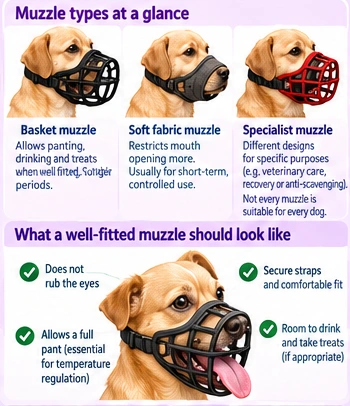
A dog may wear one for scavenging prevention, veterinary care, a legal requirement, behaviour support or an owner’s precaution. A muzzled dog should not automatically be assumed to be aggressive. Give space and ask before approaching any dog. A muzzle is a safety aid, not permission to force encounters or ignore distress.
Choose sufficient depth for a full pant, with clearance at the nose and eyes and secure, comfortable straps. Check drinking and reward delivery with that particular design. A closed-mouth fit is inadequate for walking. Not every basket is bite-resistant or scavenging-proof; purpose, strength and fit all matter. Never leave a muzzled dog unattended.
Close-fitting fabric muzzles restrict panting and are unsuitable for normal walks, exercise or hot conditions. Their use should be brief and under appropriate professional supervision. Specialist designs may address unusual face shapes, veterinary needs or scavenging. Flat-faced dogs need particularly careful professional assessment of breathing and cooling. An anti-scavenging guard must not compromise panting or drinking; no design removes all ingestion risk.
Let your dog investigate, then reward voluntarily placing their nose inside. Initially allow immediate withdrawal. Build seconds of comfortable contact before briefly touching and fastening straps, then gradually add movement and duration. Keep sessions short, allow breaks and step back if your dog freezes, paws at it or avoids it. Never force it on for routine training. Arrange veterinary or behaviour support if handling is unsafe.
Follow the exact design’s measuring landmarks: typically nose length from below the eyes to the nose tip, circumference at the specified point, and sufficient depth for the jaw to open fully. A closed-mouth circumference alone cannot establish panting room; do not force the mouth open to measure. Check the real fit, drinking and comfortable jaw movement with professional help for unusual face shapes. No standard extra number of centimeters suits every dog. Never muzzle a dog struggling to breathe, vomiting or unconscious; contact a veterinarian urgently and follow emergency handling advice. Fabric restraint is for very brief professional procedures, not a timed allowance for walking.
Choose light, proportionate hardware and check fit frequently during growth. Introduce equipment through brief rewarding sessions. Small size does not mean a toy collar or narrow strap is suitable for restraint; comfort, strength and individual anatomy matter.
Prioritise secure fit, quiet routes, distance and a clear exit. Consider a three-strap harness and suitable backup connection. Check secure fields before unclipping. Equipment does not treat the underlying emotion: a veterinarian and qualified reward-based professional can help build an individual plan.
Easy fastening, comfortable padding and short, calm outings may help. Check new rubbing, pain and changes in gait with your veterinarian. A walking harness is not automatically a lifting aid; use a professionally fitted support design if lifting or rehabilitation is needed. Consider the handler’s grip and balance too.
Keep dogs close around livestock and follow local access restrictions. Long lines can snag and are not appropriate in every setting. For scavenging, combine supervision, route choices and reward-based leave/drop training; seek veterinarian advice for persistent or sudden changes. Suspected toxic ingestion needs prompt veterinary advice even if your dog seems well.
A walking harness is not automatically designed or tested for crash restraint. Choose a vehicle-appropriate restraint, carrier or secured crate and follow its fitting instructions. Do not attach a vehicle tether to the neck collar. Keep leads and clips from becoming entanglement hazards; secure your dog before opening doors.
A size label or breed recommendation cannot establish security. Check neck opening as well as girth: a small dog can have a deep chest and narrow shoulders. Choose light but adequately rated clips, enough adjustment and straps clear of the throat and armpits. Compare designs in a secure space; seek fitting help for repeated reversing out. Use winter protection according to weather, coat and comfort; recheck with each layer rather than leaving straps loose for later.
Check the whole system’s size/load suitability, your grip and balance, and whether you can manage a sudden change of direction. Front or dual attachments can support gentle guidance but cannot guarantee control. Practise reward-based lead skills in quiet places. If you cannot safely hold the dog, arrange another capable handler and professional help before tackling busy routes.
Follow your veterinarian’s individual restrictions and instructions for wounds, lifting and activity. Avoid straps on an incision or painful area; do not improvise a sling or lift by a walking harness. For arthritis or changing gait, ask about a fitted support aid and rehabilitation. Known airway or cervical conditions need veterinary equipment advice; pressure reduction does not treat the illness. Stop for coughing, unusual fatigue or pain. Breathing difficulty, blue/grey gums or collapse requires urgent veterinary help.
Before leaving, check weather, daylight, footing, water, visibility and an emergency route. Use manageable fixed leads near steep drops and livestock; neither a long line nor a harness is climbing protection. Avoid attaching a strong or lunging dog to your waist on exposed ground. Carry identification, water and suitable warmth; reflective equipment or a light aids visibility but does not replace close control. Turn back, use a second handler or walk separately if two dogs exceed safe handling.
The GB rules below do not apply to your selected country. Check the local guidance and authority for identification, lead, muzzle, access and vehicle rules.
Great Britain only — England, Scotland and Wales: the Control of Dogs Order 1992 requires a collar bearing the owner’s name and address (on the collar or an attached plate/badge) on a highway or in a place of public resort, subject to specified exemptions. A microchip or harness does not replace that collar requirement. Highway Code rule 56 advises a short lead on sidewalks, roads and paths shared with cyclists or horse riders, and no dog out alone on the road. Rule 57 advises suitable vehicle restraint to avoid distraction and injury. These are advisory Code provisions, not standalone offences; separate driving offences may still apply. Northern Ireland: separate identification rules require the owner’s name and address on a collar or attached plate/badge, with specified exemptions. A telephone number is a useful additional contact, not a substitute for required details. Wales prohibits the use of electronic shock collars under the Animal Welfare (Electronic Collars) (Wales) Regulations 2010. Do not extrapolate that restriction to other jurisdictions. Check current local lead, access and muzzle conditions, including any conditions applying to an individual dog. Do not apply this GB summary internationally.
Identification and local responsibilities · Travelling with dogs
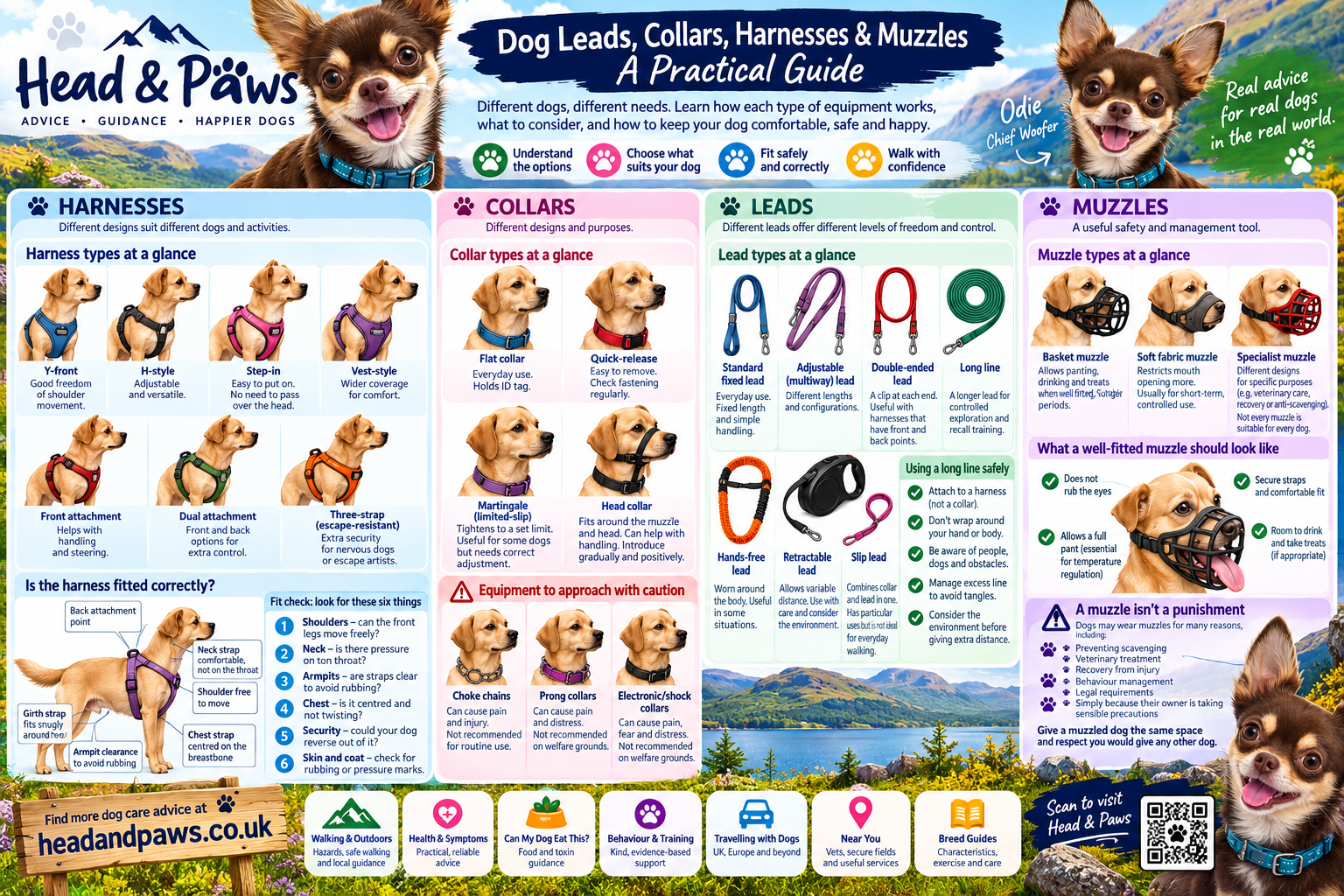
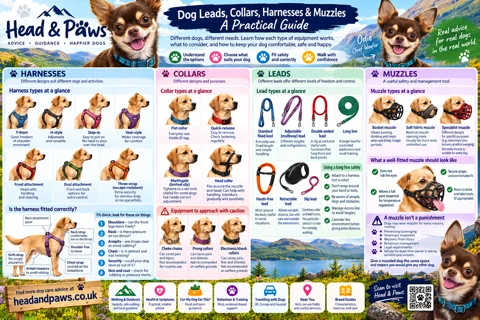
The approved combined poster features Odie, Head & Paws Chief Woofer. Optional English-language resource; the individual diagrams and all safety guidance remain on this page.
Download original-resolution PNG1536 × 1024 px · PNG · Original artwork; large-format print quality is limited by this resolution. For readable safety guidance, print this HTML page as well.
© 2023–2026 Head & Paws. All rights reserved. Personal, non-commercial printing permitted. · headandpaws.co.uk
It depends on fit, health and the activity. A comfortable harness can avoid loading the neck, while a collar may still be needed for identification.
Snug without restricting breathing or movement, clear of the throat and armpits, and secure against backing out. Check during movement, not only while standing still.
Use an appropriate back point on a well-fitted harness. Sudden stops on a neck or head attachment can cause injury.
Its chest straps form a Y at the front. Assess the individual design and fit rather than assuming the name guarantees free movement.
Often a three-strap design with an extra body strap to make reversing out harder. It still requires careful fitting, supervision and a safe handling plan.
No. Variable distance and thin line can create hazards near traffic, crowds and other animals. Use close, predictable control where needed.
Scavenging prevention, veterinary care, legal requirements and sensible precautions are among the reasons. Wearing one does not automatically mean a dog is aggressive.
Allow a full pant, avoid rubbing the eyes or nose, and keep straps secure and comfortable. Check drinking with the actual design.
A suitable, well-fitted basket should permit both. Close-fitting fabric designs restrict panting and are not suitable for ordinary walks or exercise.
Research finds that harness effects vary by design and individual dog; short-term gait measurements do not establish long-term injury or a universally best shape. The practical checks here are owner decision support, not a clinical assessment. Manufacturer measurements and veterinary instructions take precedence for a particular dog.
Editorial review: 21 October 2026. General guidance, not an individual veterinary or behaviour assessment. Recognised welfare guidance supports practical advice; primary official sources support legal statements.
A flexible day of movement, sniffing, learning and rest. Start with the dog in front of you, not a breed target.
Build my routineBreed directory & Compare Breeds · Health & symptoms · Emergency? Call a veterinarian now · Can My Dog Eat This? · My Dog Ate This
Clothing must not compromise harness security, front or rear lead attachments, movement, breathing, identification or visibility. A warm jumper and weather-resistant coat serve different purposes. Recheck the complete fit with each change of layers.
Addition reviewed 30 September 2026 ·
Practical addition reviewed 12 October 2026. Original handling synthesis; general guidance, not an individual assessment. Related evidence: Dogs Trust: puppy problem-solving · Dogs Trust: escape prevention
Practical addition reviewed 12 October 2026. Original handling synthesis; general guidance, not an individual assessment. Related evidence: Dogs Trust: puppy problem-solving · Dogs Trust: escape prevention