Head & Paws · The Head & Paws Kitchen
The Little Full English
Breakfast is served. Second breakfast is under negotiation.

What we’re making
A British cooked breakfast, rebuilt as plain egg, lean turkey, potato and vegetables. The little turkey crumbles take the place of a sausage; there is no processed meat.
An occasional treat, not a complete everyday meal. For allergies, illness or a prescribed diet, check with your veterinary team before cooking.
Preparation: 10 min · Cooking: 35 min · Total: 45 min
One batch: 330 g raw edible ingredients, plus water. Cooking changes the weight: weigh the whole cooled batch. It makes several treat portions, not one complete dinner; the number depends on your dog’s allowance.
What you’ll need
Ingredients
Weights are raw edible weights, after peeling or trimming. Use plain, unseasoned ingredients. No added oil, butter, milk, salt or stock.
- 100 g boneless skinless turkey breast
- 50 g beaten egg without shell (about one small egg)
- 100 g peeled potato
- 50 g carrot
- 30 g peas (plain fresh or frozen)
- 50 ml water, plus enough for boiling or poaching
Equipment
Digital kitchen scales, separate raw-food board and knife, clean food thermometer, spoon, plate and shallow storage containers. Saucepan with lid and sieve for the vegetables. Small saucepan for turkey and non-stick frying pan for egg.
A little prep first
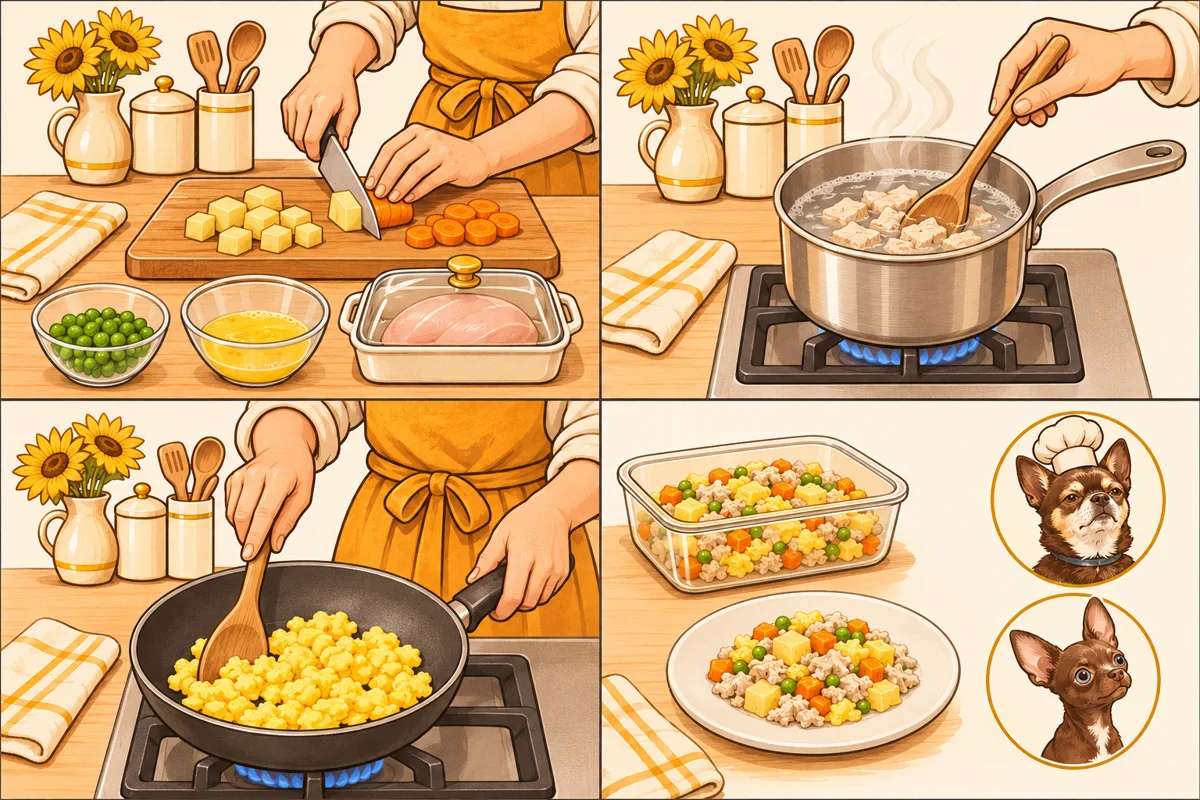
Wash and weigh the vegetables first. An adult cuts the peeled potato into 1 cm pieces and carrot into 5 mm pieces. Keep the measured peas ready. Keep raw turkey and its utensils separate from the vegetables and cooked food. Cut the turkey into 1 cm pieces before simmering.
Wash hands, utensils and surfaces, and keep raw ingredients away from cooked food. Fully thaw frozen turkey in the fridge before you begin. Do not wash raw poultry. Peel potatoes and discard green or sprouting ones. Use a clean thermometer for doneness; cooking times are a guide.
Leave out bacon, seasoned sausages and black pudding: their salt, fat and seasonings make them poor choices here, and some contain onion. Conventional baked beans may contain too much salt, sugar or onion; they are not needed. These are suitability concerns, not a claim that every bean or every mouthful is poisonous.
Let’s get cooking!
Lovely soft vegetables
Start with the prepared potato and carrot in a saucepan. Cover with water, bring to the boil and simmer 12–15 minutes until a fork crushes both easily.
Add the listed peas for the last 4 minutes. Drain.
Follow packet instructions if frozen vegetables need longer.
Cook the turkey
Illustrated cooking stage — Plain turkey pieces simmer in water while an adult stirs. Odie: “The breakfast briefing is now in session.”
Cut turkey into 1 cm pieces. Simmer in a small pan with the 50 ml water for about 8–12 minutes, stirring and adding a splash more water if needed.
Check the thickest pieces reach 75°C for at least 30 seconds (167°F), then crumble on a clean plate.
Scramble the egg
Illustrated cooking stage — An adult gently scrambles the egg until fully set, without butter or oil. Odie: “Everything measured? Excellent. Standards matter.”
In a separate small non-stick pan, gently stir the beaten egg with a tablespoon of water for about 3–5 minutes until completely set, with no runny egg. Do not add butter or oil.
Breakfast comes together
Time to build breakfast! Arrange turkey, cooked egg, soft potato, carrot and peas in little sections.
Before portioning, mix them evenly or measure the same small fraction of each component.
Cool it down, then dish up
Finn: “I’m practising waiting. It’s a demanding skill.”
Time for a little breakfast! Crumble the cooked turkey and egg, squash the peas and soften the potato with a fork. Cut the soft carrot into mouth-sized pieces. Cool the measured portion to room temperature before serving. Mix the batch evenly before weighing your allowance, or take the same small fraction of each component. An adult serves in a quiet space. Put the untouched rest away promptly — it is not an invitation for second helpings.
Little Kitchen Helpers
Fancy being today’s little kitchen helper?
Fancy helping with breakfast? Help weigh the washed vegetables. Once an adult has cooked and fully cooled everything, use a clean spoon to arrange the measured egg, turkey and little vegetables.
A quick note for the grown-ups
Match tasks to your child’s age, ability and confidence, with active adult supervision. Wash hands before and after. Adults handle raw meat and fish, knives, heat, hot food and cleaning. Keep dogs outside the cooking area; an adult checks and serves the portion, then everyone gives the dog space to eat. Children should not hand-feed.
The grown-up stays in charge of raw ingredients, knives, heat and serving. Wash hands and let the dog eat undisturbed.
Small-dog portions
Make a batch, serve a little. Use the worksheet to work out the remaining treat allowance, then weigh that amount from the evenly mixed, cooled food. Start with a tiny taste if an ingredient is new. The picture shows a batch to divide, not one dog’s recommended serving.
- Whole cooled batch
- Weigh your allowance
- Cut into little bites
Finn: “Small dog. Small plate. Very large appetite.”
These are occasional treats, not complete meals. All extras together should generally stay within 10% of daily calories, counted within the daily allowance, with at least 90% from complete food. Needs vary: use your dog’s feeding plan and the label-based worksheet, not plate size or weight alone.
Your portion worksheet
Use kcal (food Calories), not kJ. Sum each ingredient’s grams × its label kcal per 100 g ÷ 100 to estimate the batch energy. Include every ingredient and count all treats already given today. This is an estimate, not a prescription; if a label is missing, use a verified food-composition entry matching the ingredient and preparation or ask your veterinary team.
Illustrations only: a dog on 200 kcal/day has at most 20 kcal for all extras; on 600 kcal/day, 60 kcal; on 1,200 kcal/day, 120 kcal. These may suit some small, medium or large dogs respectively, but are not weight-based feeding recommendations. Any other treats reduce this budget.
Save some for another day
Separate untouched leftovers into shallow containers promptly. Cool and refrigerate within 1–2 hours at 5°C or below; use within 48 hours of cooking. Freeze small labelled portions promptly at −18°C; aim to use within one month for quality. Defrost in the fridge and use within 24 hours of full thawing. Reheat only once until steaming hot throughout (for a thermometer check, 70°C for 2 minutes), stir and cool the serving again. Never serve hot. Discard food left in the dog’s bowl, food kept at room temperature for more than 2 hours, or leftovers with uncertain storage; smell is not a reliable safety check.
Nutrition, suitability & ingredient swaps
Ingredient substitutions
Use plain chicken breast instead of turkey if preferred, cut to the same size and cooked to 75°C for 30 seconds. Recalculate its calories. If egg is unsuitable, leave it out rather than adding an untested replacement: the raw food batch becomes 280 g and its energy changes. Soft chopped green beans can replace peas by weight; simmer until easily crushed. Recalculate batch energy after any change. Introduce new ingredients gradually; for allergies, digestive illness or a prescribed diet, check the feeding plan with your veterinary team first.
Nutrition & portions
This recipe is not complete and balanced. Keep the usual complete diet as the foundation; treats and extras together should generally supply no more than 10% of daily calories. Count extras within the daily total and reduce the usual ration by their calories, keeping at least 90% from complete food. Age, activity, body condition, medical needs and existing food all affect the allowance. A larger “special meal” needs a veterinary feeding plan rather than simply replacing a whole bowl of complete food.
We have not measured cooked yield or established a verified calorie value for this recipe. Fat content, labels and moisture loss vary, so no fixed grams-per-dog serving or calorie claim is given. Use the label-based portion worksheet below; if you cannot establish the calories, keep this to a tiny taste and ask your veterinary team for a suitable allowance.
For a healthy dog who tolerates the ingredients. Dogs with allergies, pancreatitis, digestive or kidney disease, prescribed diets, and puppies with particular nutritional needs may need individual veterinary advice before trying it. No onion, garlic, chives, leeks, grapes, raisins, xylitol or cooked bones. If poisoning is suspected, contact a vet promptly.
Feeding & food suitability
Feeding & food suitability · Food lookupEvidence & editorial notes
Recipes are editorial adaptations informed by the sources below. They have not been independently cooked, taste-tested or clinically validated. Images are AI-generated serving illustrations, not photographs of tested recipes; they show a batch to divide, not a recommended serving.
- PDSA — Children and dogs
- Dogs Trust — Dogs and children
- WSAVA — Feeding treats to your dog
- PDSA — How to treat your dog
- PDSA — Christmas dinner
- Dogs Trust — Diet and nutrition
- Blue Cross — Fruit and vegetables
- Blue Cross — Poisonous foods
- Food Standards Agency — Cooking
- Food Standards Scotland — Chilling
- Food Standards Agency — Chilling