Puppy
Light hardware, gentle introductions and frequent fit checks as your puppy grows.
Read the detailHead & Paws · Practical equipment guide
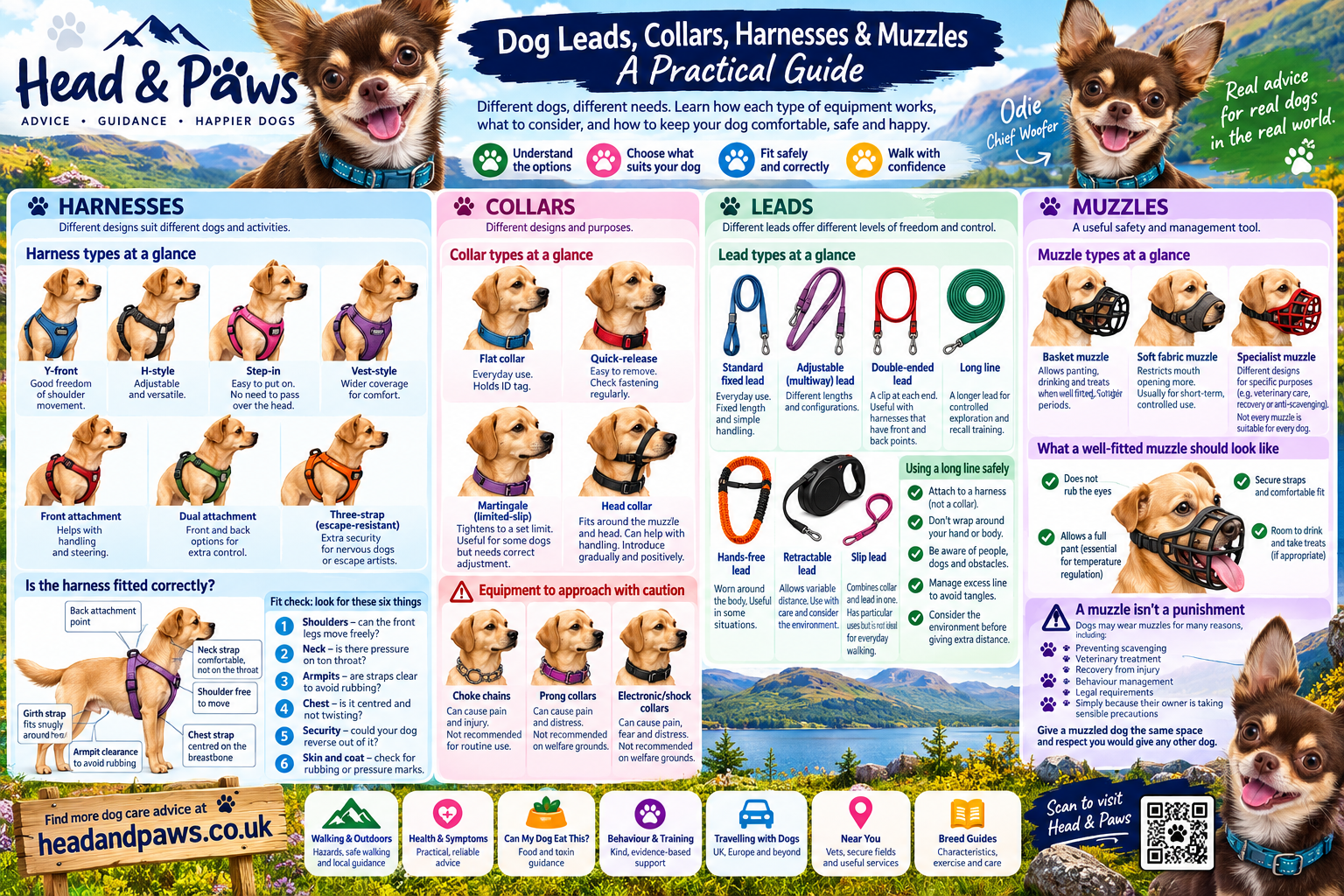
Different dogs, different needs. Understand the options, check the fit and choose features that help your dog feel comfortable and secure. Equipment supports kind training; it does not resolve fear, pulling or reactivity on its own.
Choose all that apply. These are features to consider, not a prescription or a product recommendation.
Choose a consideration to see relevant guidance.
Light hardware, gentle introductions and frequent fit checks as your puppy grows.
Read the detailProportionate straps and clips; assess anatomy and comfort rather than a breed label.
Read the detailConsider a properly fitted three-strap harness and suitable backup attachment. No harness is escape-proof; plan quiet routes and safe exits.
Read the detailA comfortable harness and fixed or double-ended lead can support gentle handling. Front clips may alter movement under tension. Reward loose-lead walking; avoid jerks.
Read the detailA long line on a suitable harness back attachment can support recall practice in a safe area. Manage slack and never wrap it around your body or hands.
Read the detailPrioritise space, secure fit and a safe exit. A positively introduced basket muzzle may add safety where appropriate; it does not replace a behaviour plan.
Read the detailLook for easy fastening and comfortable contact. Ask your vet about pain or gait changes; use a purpose-designed support aid if lifting is needed.
Read the detailA well-fitted harness or suitable flat collar with a fixed lead offers predictable handling. Check clips and identification before leaving.
Read the detailUse close control near livestock and roads; follow local restrictions. Long lines can snag. Plan water, visibility and a route suited to your dog.
Read the detailAn appropriately fitted anti-scavenging basket design may help, provided full panting and drinking remain possible. It cannot remove all risk; combine supervision and leave/drop training.
Read the detailChoose a suitable basket design with full panting room, then reward voluntary nose entry before gradually introducing straps and movement.
Read the detailDifferent dogs, different needs. Understand the options, check the fit and choose features that help your dog feel comfortable and secure. Equipment supports kind training; it does not resolve fear, pulling or reactivity on its own.
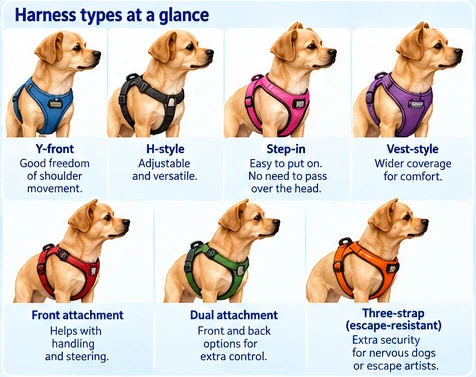
The chest straps form a Y when viewed from the front. Look for space around the shoulders and neck, with the centre resting on the breastbone rather than the throat. The name alone does not guarantee unrestricted movement or a good fit.
Usually has neck and chest loops linked along the back and underneath. Adjustment can suit different proportions, but check that straps stay clear of the armpits and do not twist.
The dog places their front feet into openings before fastening. This may help a dog who dislikes equipment passing over their head, but handling feet may worry another dog. Never force a leg into position.
A larger fabric area may feel comfortable for some dogs. Check heat, drying time, seams and freedom of movement; padding does not make a poor fit safe.
A back attachment keeps the lead away from the face and is usually the appropriate point for a long line. A front attachment can help gentle guidance but may turn the harness or affect gait under tension. Dual attachment allows a double-ended lead to connect at both points. Avoid jerks and continual sideways pressure; none teaches loose-lead walking by itself.
An additional strap behind the ribcage can make backing out harder when properly fitted. Escape-resistant does not mean escape-proof. Check the whole design, buckles and movement; consider an independently secured collar connection with professional fitting advice for a dog at risk.
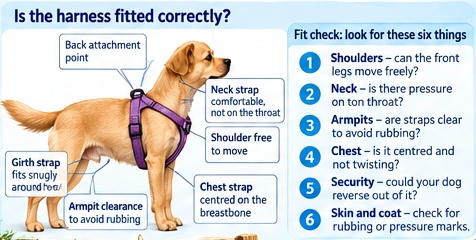
Measure as directed for that design. Straps should be snug without compressing breathing, skin or movement; finger clearance is a guide, not a universal sizing rule. Check six things: free shoulder movement; no throat pressure; clear armpits; a centred chest section; security against reversing out; and no rubbing or pressure marks. Watch walking, turning, sitting and backing up in a secure area. Recheck after settling, coat changes, washing, weight changes and puppy growth. Replace damaged stitching, clips or webbing.
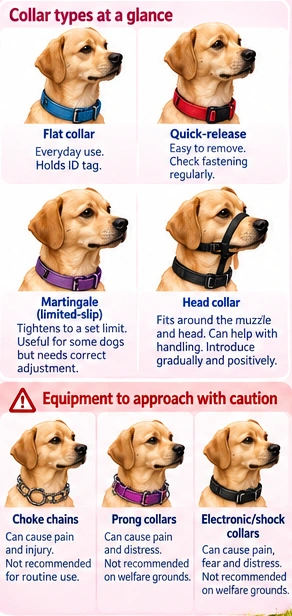
A flat collar can carry identification and suit a dog who walks comfortably without pulling. A quick-release buckle is a fastening type, not a guarantee that it releases under load or is escape-proof. Check fastening and fit, and keep loose loops away from snag hazards. A harness can reduce reliance on neck pressure while the identification collar remains in place.
Tightens to a set limit. It may help certain dogs whose head is narrower than their neck, but incorrect adjustment can still constrict or injure. Obtain fitting help; do not use it to correct pulling, attach a long line or leave a dog unattended.
Fits around the muzzle and head to guide direction. It is not a muzzle and does not prevent biting. Introduce gradually with rewards, use gentle handling and an appropriate backup connection, and never jerk the head or attach a retractable lead or long line. Stop if rubbing, panic or discomfort occurs.
Choke chains, prong collars and equipment delivering shocks can cause pain, fear and distress. Choose reward-based support instead of using discomfort to suppress behaviour. Legal restrictions vary by jurisdiction; do not infer legality from availability for sale. Ask a vet about pain or sudden behaviour changes and seek a suitably qualified, reward-based professional.
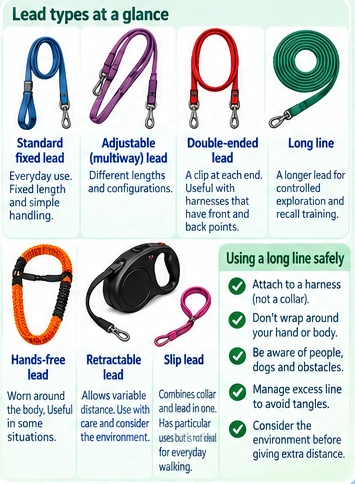
A standard fixed lead offers predictable length for everyday walking and close control. Adjustable/multiway leads change length or configuration: check that every clip is on a load-bearing attachment. A double-ended lead can connect to two suitable points; manage both ends without tangling legs or maintaining constant tension.
Use a suitable back attachment on a well-fitted harness, not a collar or head collar. Practise recall in a quiet, secure space before adding distance and distractions. Manage slack so a dog cannot accelerate into the end; never wrap line around hands or your body. Keep it clear of people, dogs, roads, livestock and obstacles. Gloves may reduce friction burns but do not eliminate injury risk. A long line is not a tie-out.
Hands-free designs attach to your body: consider balance, dog strength and a safe release before use. They may be unsuitable with sudden lunging or reduced stability. Retractable leads allow variable distance but can cause burns, entanglement and loss of control; avoid roads, crowds, close encounters and unpredictable situations. Do not grab the moving cord. A fixed lead is usually easier for close, predictable handling.
Combines a lead with a loop around the neck that tightens under tension. It has limited specialist handling uses but can compress the neck and is not a routine solution for pulling, puppies or fearful dogs. Seek professional advice where its use is necessary; do not use as a long line, tie-out or unattended restraint.
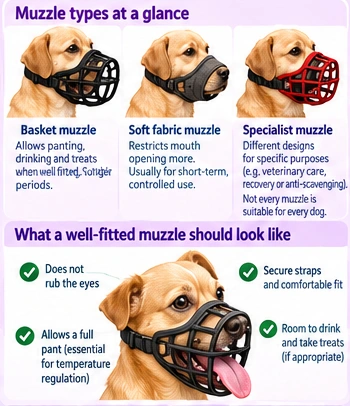
A dog may wear one for scavenging prevention, veterinary care, a legal requirement, behaviour support or an owner’s precaution. A muzzled dog should not automatically be assumed to be aggressive. Give space and ask before approaching any dog. A muzzle is a safety aid, not permission to force encounters or ignore distress.
Choose sufficient depth for a full pant, with clearance at the nose and eyes and secure, comfortable straps. Check drinking and reward delivery with that particular design. A closed-mouth fit is inadequate for walking. Not every basket is bite-resistant or scavenging-proof; purpose, strength and fit all matter. Never leave a muzzled dog unattended.
Close-fitting fabric muzzles restrict panting and are unsuitable for normal walks, exercise or hot conditions. Their use should be brief and under appropriate professional supervision. Specialist designs may address unusual face shapes, veterinary needs or scavenging. Flat-faced dogs need particularly careful professional assessment of breathing and cooling. An anti-scavenging guard must not compromise panting or drinking; no design removes all ingestion risk.
Let your dog investigate, then reward voluntarily placing their nose inside. Initially allow immediate withdrawal. Build seconds of comfortable contact before briefly touching and fastening straps, then gradually add movement and duration. Keep sessions short, allow breaks and step back if your dog freezes, paws at it or avoids it. Never force it on for routine training. Arrange veterinary or behaviour support if handling is unsafe.
Choose light, proportionate hardware and check fit frequently during growth. Introduce equipment through brief rewarding sessions. Small size does not mean a toy collar or narrow strap is suitable for restraint; comfort, strength and individual anatomy matter.
Prioritise secure fit, quiet routes, distance and a clear exit. Consider a three-strap harness and suitable backup connection. Check secure fields before unclipping. Equipment does not treat the underlying emotion: a vet and qualified reward-based professional can help build an individual plan.
Easy fastening, comfortable padding and short, calm outings may help. Check new rubbing, pain and changes in gait with your vet. A walking harness is not automatically a lifting aid; use a professionally fitted support design if lifting or rehabilitation is needed. Consider the handler’s grip and balance too.
Keep dogs close around livestock and follow local access restrictions. Long lines can snag and are not appropriate in every setting. For scavenging, combine supervision, route choices and reward-based leave/drop training; seek vet advice for persistent or sudden changes. Suspected toxic ingestion needs prompt veterinary advice even if your dog seems well.
A walking harness is not automatically designed or tested for crash restraint. Choose a vehicle-appropriate restraint, carrier or secured crate and follow its fitting instructions. Do not attach a vehicle tether to the neck collar. Keep leads and clips from becoming entanglement hazards; secure your dog before opening doors.
Great Britain only — England, Scotland and Wales: the Control of Dogs Order 1992 requires a collar bearing the owner’s name and address (on the collar or an attached plate/badge) on a highway or in a place of public resort, subject to specified exemptions. A microchip or harness does not replace that collar requirement. Highway Code rule 56 advises a short lead on pavements, roads and paths shared with cyclists or horse riders, and no dog out alone on the road. Rule 57 advises suitable vehicle restraint to avoid distraction and injury. These are advisory Code provisions, not standalone offences; separate driving offences may still apply. Northern Ireland has separate rules. Do not apply this GB summary internationally.
Identification and local responsibilities · Travelling with dogs
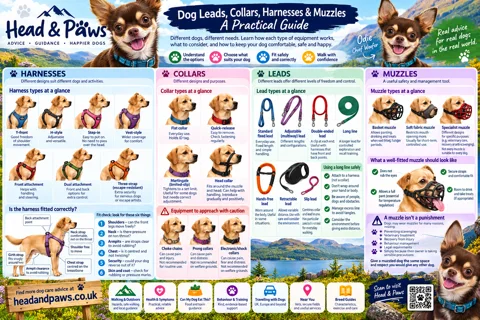
The approved combined poster features Odie, Head & Paws Chief Woofer. Optional English-language resource; the individual diagrams and all safety guidance remain on this page.
Download original-resolution PNG1536 × 1024 px · PNG · Original artwork; large-format print quality is limited by this resolution. For readable safety guidance, print this HTML page as well.
© 2023–2026 Head & Paws. All rights reserved. Personal, non-commercial printing permitted. · headandpaws.co.uk
It depends on fit, health and the activity. A comfortable harness can avoid loading the neck, while a collar may still be needed for identification.
Snug without restricting breathing or movement, clear of the throat and armpits, and secure against backing out. Check during movement, not only while standing still.
Use an appropriate back point on a well-fitted harness. Sudden stops on a neck or head attachment can cause injury.
Its chest straps form a Y at the front. Assess the individual design and fit rather than assuming the name guarantees free movement.
Often a three-strap design with an extra body strap to make reversing out harder. It still requires careful fitting, supervision and a safe handling plan.
No. Variable distance and thin line can create hazards near traffic, crowds and other animals. Use close, predictable control where needed.
Scavenging prevention, veterinary care, legal requirements and sensible precautions are among the reasons. Wearing one does not automatically mean a dog is aggressive.
Allow a full pant, avoid rubbing the eyes or nose, and keep straps secure and comfortable. Check drinking with the actual design.
A suitable, well-fitted basket should permit both. Close-fitting fabric designs restrict panting and are not suitable for ordinary walks or exercise.
Editorial review: 26 September 2026. Next review due: 10 October 2026. General guidance, not an individual veterinary or behaviour assessment. Recognised welfare guidance supports practical advice; primary official sources support legal statements.
A flexible day of movement, sniffing, learning and rest. Start with the dog in front of you, not a breed target.
Build my routineBreed directory & Compare Breeds · Health & symptoms · Emergency? Call a vet now · Can My Dog Eat This? · My Dog Ate This